
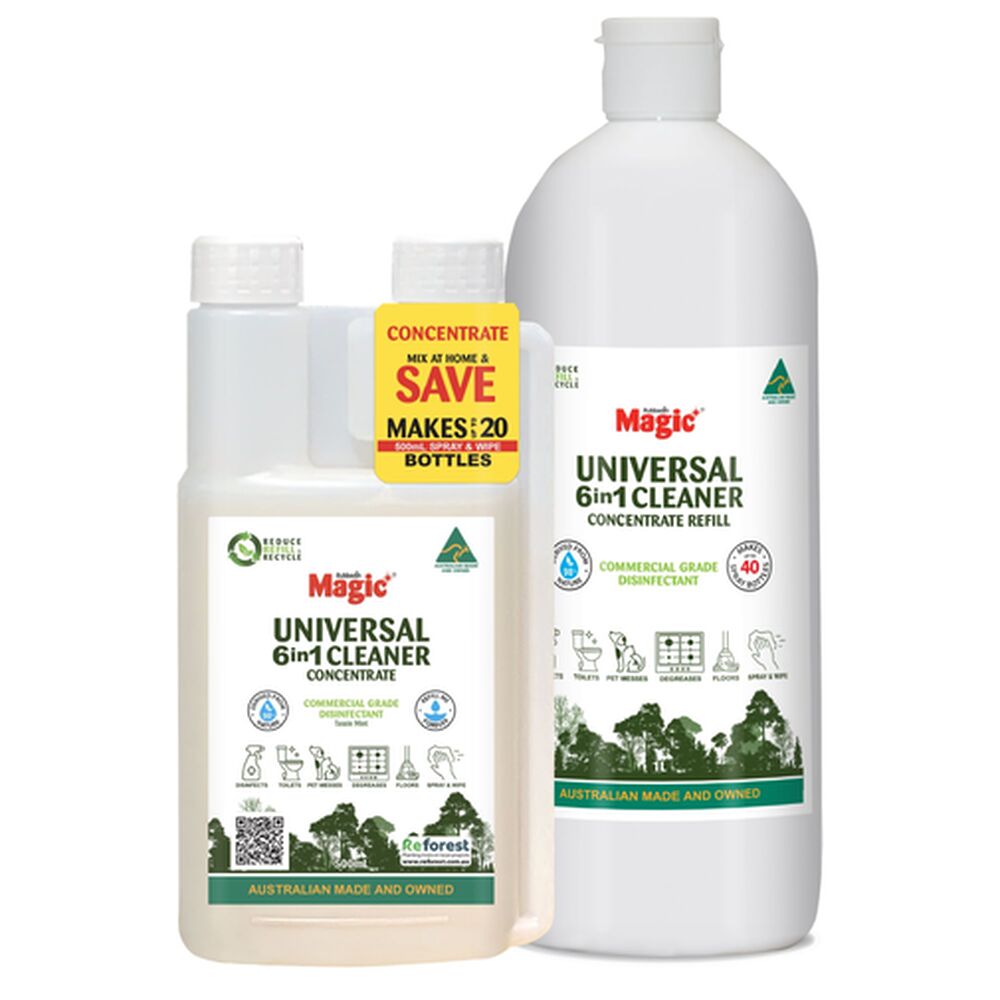
Universal 6in1 Concentrate Cleaner 500mL

Universal 6in1 Concentrate Cleaner 500mL

Magic Universal 6in1 Cleaner Concentrate, made from 98% natural ingredients, 500mL makes up to 20 spray bottles. Perfect for pet messes and toilets, it is packed in a refillable bottle. It breaks tradition by harnessing the power of naturally derived Surfactin and Thymol.

What can our 6in1 do?

  • Commercial Grade Disinfectant (Kills 99.99% of germs)
  • Toilet & Urinal Cleaner (Cleans & Removes Odours)
  • Pet Messes (Cleans & Removes Odours)
  • Degrease (Fat, Oil and Grease)
  • Cleaning Floors
  • Multi-purpose Spray & Wipe (Pleasant Tazzie Mint Fragrance)

Fact Sheet

Test Reports

Product Description

Reducing single-use plastics and protecting our environment is our mission. Magic Universal 6in1 Cleaner is not only a great cleaner, but it also reduces plastic waste. By using the concentrate to refill your spray bottle, you can save up to 20 plastic bottles going to landfill each year.

It is naturally derived, sustainably sourced, and safe for food-contact surfaces. It effectively breaks down germ cells, dirt, fats, oils, and grease so they can be washed away. It also helps clean and remove odours from small accidents, such as those made by pets, children, and the elderly.

Plastic bottles on beach
 

Rather than using nasty chemicals or bleach to kill germs, this one-of-a-kind product breaks tradition by uniquely combining our naturally derived Surfactin[1] with other bio-surfactants[3] and Thymol[2], a natural disinfectant. This makes it a powerful, environmentally friendly disinfectant and cleaner that requires minimal protective gear.

Ideal for:

  • Pet Messes, Toilets, Urinals
  • Kitchens and BBQs
  • Bathrooms, Showers
  • Flooring: Timber, Polished Concrete, Linoleum, Tiles and Grout
  • Drains

Handy Hint: To help maintain clear drains, pour the balance of the floor cleaning solution down the drain. For a crystal clear finish on glass, use PuraChoice Glass Cleaner.


How to Use

How to dilute and use the measuring chamber.

  1. Make sure the cap for the main chamber is on and airtight.
  2. Remove the cap from the small chamber.
  3. Squeeze the main bottle until the required amount of liquid is in the small chamber.
  4. Pour from the small chamber into your bottle or bucket.
  5. To avoid excess foaming, slowly top the bucket or bottle with water.
  6. Shake or stir well, and it is ready to use.

Note: Magic Universal 6in1 Cleaner is low-foaming. Do not use it on stone benchtops, as it is acidic and could etch the surface.

DILUTION RATE
Application Dilution mL / Liter 500mL Concentrate Makes
Disinfecting Use Undiluted 1 x 500mL Spray Bottle
Sanitising Spray 125mL with 375mL water 5 x 500mL Spray Bottles
Toilets & Odour Control 50mL with 450mL water 10 x 500mL Spray Bottles
Degreasing 50mL with 450mL water  10 x 500mL Spray Bottles
Pet Messes & Odour Control 50mL with 450mL water  10 x 500mL Spray Bottles
Floors 125mL with 5 Liters water 40L (est. 7-10 Buckets)
General Spray & Wipe 25mL with 475mL water  20 x 500mL Spray Bottles


DIRECTIONS HOW TO USE

Disinfectant: Remove heavy dirt from the surface first, apply it undiluted with spray or a cloth, and ensure the entire surface is covered. Leave for 10 minutes, then wipe off with a damp cloth. Rinse food-contacting surfaces with clean water before use.

Sanitising: Apply with spray or apply with a cloth. Ensure the entire surface is covered and allowed to dry.

Toilets, Urinals & Odour Control:
Heavily Soiled Areas – Soak with the undiluted solution for up to 30 minutes before scrubbing.
Maintenance – Spray the area, soak for 2-3 minutes, scrub, and wash down. 

Pet Messes & Odour Control: Spray the area, soak for 2-3 minutes, scrub, and wash down. For heavily soiled areas, soak with the undiluted solution for up to 30 minutes before scrubbing.

Degreasing: Spray onto the surface, wait 30 seconds, scrub if required, then wipe with a clean cloth.

Floors: Mop the floor and allow it to dry. Help keep your drain clean. Pour balance down the drain after mopping.

Multi-purpose Spray & Wipe: Spray onto the surface and wipe with a clean cloth.

Note: Heavily soiled areas may need repeat treatments. Food contact surfaces must be rinsed before use.

The Science

  1. Surfactin: https://www.sciencedirect.com/science/article/pii/S0927776521001934

Highlights

  1. High-purity surfactin was recovered from a Bacillus subtilis culture broth.
  2. Purified surfactin efficiently reduces interfacial tension at low concentrations.
  3. Surfactin was characterized regarding its applicability as O/W emulsifier.
  4. Emulsions were stable at pH values above 6 and NaCl concentrations up to 0.5 M.
  5. Emulsions had highly negative zeta-potentials up to −100 mV.
  1. Thymol: https://www.ncbi.nlm.nih.gov/pmc/articles/PMC5483461/
    Thymol, chemically known as 2-isopropyl-5-methylphenol is a colourless crystalline monoterpene phenol. It is one of the most important dietary constituents in thyme species. For centuries, it has been used in traditional medicine and has been shown to possess various pharmacological properties including antioxidant, free radical scavenging, anti-inflammatory, analgesic, antispasmodic, antibacterial, antifungal, antiseptic and antitumor activities.
  2. Biosurfactants: https://www.sciencedirect.com/topics/medicine-and-dentistry/biosurfactant

Biosurfactants are active compounds that are produced at the microbial cell surface or excreted and reduce surface and interfacial tension. Microbial surfactants offer several advantages over synthetic ones, such as low toxicity and high biodegradability, and remain active at extreme pH and salinity. Biosurfactants are produced by bacteria, yeasts, and filamentous fungi.

  1. The Chemistry of Cleaning – How Surfactants Work: https://www.cleaninginstitute.org/understanding-products/science-soap/chemistry-cleaning
    In order to clean dirt off our clothes and surfaces, the water needs to be able to reach the surface. Water is able to get to the surface if surface tension is reduced. To do this, we use a group of chemicals called surface active agents, or surfactants. Surfactants change how water behaves. When a surfactant is added, the surface tension is reduced. Now water can spread out and wet the surface (e.g., clothes, dishes, counter tops) we are trying to clean.

Every surfactant has two ends. One end wants to be in water and the other does not. How these two ends interact with soil and water is the secret to how a surfactant works. Once the surfactant is added to water, the water-fearing ends try to stay away from the water.3,4 Watch this video4 to see how… https://youtu.be/F7-ie4uWX04

  1. How Surface Tension is Measured: https://www.ncbi.nlm.nih.gov/pmc/articles/PMC8433748/

The critical micellar concentration (cmc) is a fundamental property of a surfactant solution. At surfactant concentrations near and above the cmc the surfactant molecules start to aggregate and form micelles. The formation of micelles affects many properties of a surfactant solution introducing usually a marked change at the cmc in plots of a property versus the surfactant concentration.

  1. What is Quick Breaking, and why is it important

https://cleanawater.com.au/information-centre/how-quick-break-degreasers-work

Many water authorities require oil water separators as a pre-treatment for wastewater before it is discharged into the sewer system. This is aimed at protecting downstream water processing plants from excessive oil and grease, and preventing hydrocarbon spills into the environment.

However, oil water separators only work when the wastewater is free from emulsions. This is where quick break degreasers are effective.

How quick-break degreasers work

Degreasers dissolve hydrocarbons in water in the form of an emulsion. They break oil down into tiny droplets that mix in between the water droplets.

  • An emulsion keeps oil droplets so small that they do not separate from the water.
  • The result is a dirty, foamy-looking wastewater.
  • It is impossible to tell how much oil is trapped in the emulsion.

Quick-break degreasers perform this function, then quickly release the oil droplets from the emulsion.

  • Once the emulsion is broken, oil droplets stick together to form larger droplets.
  • The larger oil droplets are easier to separate from the water.